A Familiar Street, Seen Through Its Doorways
A familiar street walk can feel newly attentive when you focus on doorways, noticing color, shape, thresholds, and small details without needing a destination.
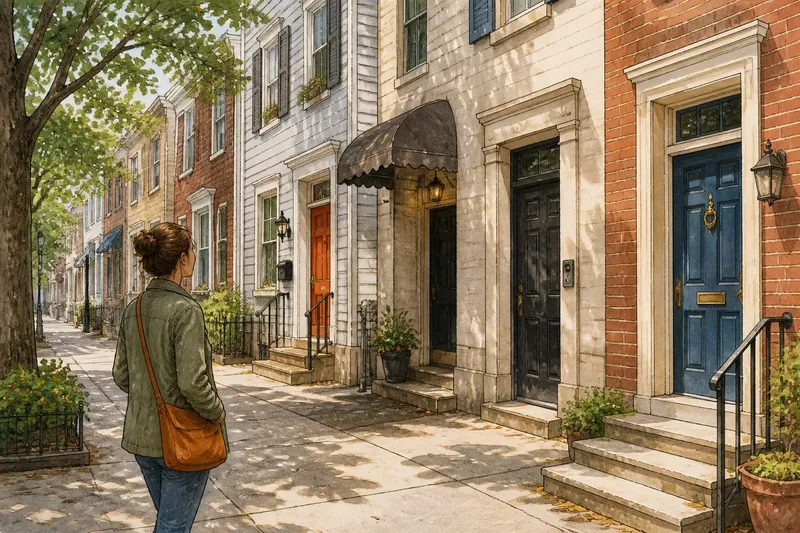
A familiar street walk can feel newly attentive when you choose one detail to notice, such as doorways. Instead of heading toward a landmark, you can follow the changing shapes, colors, and small signs of use along a route you already know.
Imagine that Mara has a free stretch of afternoon and often walks the same few blocks near home. She wants to get outside, but the usual route has become little more than a way to reach the corner shop. She decides to look at doorways—not to photograph every one or judge which is prettiest, but to notice how each entrance meets the street.
A familiar route
Mara begins on her usual block, where she knows which sidewalk squares tilt and where a tree narrows the path. This familiarity makes the walk easy to start: she does not need directions, a reservation, or a destination to justify going out.
She gives herself a simple boundary: walk to the next cross street and back, using the same public sidewalks she normally takes. The boundary keeps the outing relaxed, while the chosen detail gives her attention somewhere to land. She can turn back sooner or extend the loop if the street feels busy or the weather shifts.
Before setting off, she puts her phone away and chooses one question: what changes from doorway to doorway? That question is broad enough to keep the walk open, but specific enough to interrupt the habit of looking straight ahead.
Looking at thresholds
The first entrance is set back from the sidewalk, with a short path and a low gate. Mara notices how the retreat creates a little pause between street and home. At the next building, the door sits almost flush with the brick face, so the threshold feels more direct.
She starts to see that a doorway is not just a slab of wood or glass. Its frame, steps, lighting, mailbox, handle, and surrounding wall all shape the way it meets the public street. She does not need to infer who lives there or what their routines are; the visible details are enough to hold her interest.
At a corner, she notices a recessed entry beneath a small canopy. Rain has left a darker line on the pavement beyond it, making the sheltered patch easy to see. She pauses on the public sidewalk, out of the way, and observes how the canopy changes the entrance’s outline.
Small differences
Once Mara has noticed depth and shelter, other distinctions emerge. Some doors are bright against plain siding; others nearly disappear into a row of similar brick. A narrow glass panel lets light show through, while a solid door gives the entrance a quieter face.
She also notices what changes with the season. A pot beside one threshold holds a few sturdy leaves, while another entrance has a bare mat and a swept step. These details suggest care without telling her a full story, and she lets that limit be part of the pleasure: observation does not require a guess about a stranger.
At one point, she sees a hand-painted number and a small brass knocker. At another, a modern intercom sits beside an older stone frame. The contrast prompts a useful question: which parts of the entrance seem to belong to the building, and which appear to have been added later? She cannot know the answer from the sidewalk, but looking for the contrast makes the block feel more varied.
Keeping the walk considerate
A doorway is personal space, even when it faces a public street. Mara stays on the sidewalk, avoids peering through windows, and does not photograph residents, visitors, or private interiors. If an entrance is behind a gate or marked as private, she treats it as something to notice from a respectful distance rather than approach.
She keeps her pace comfortable and steps aside when someone needs to pass. When a person comes out of a building, she shifts her attention to the street rather than watching them. The point is to see the design of the threshold, not to turn anyone’s arrival or departure into part of the outing.
She also lets traffic and other people take priority. If stopping would block a narrow sidewalk, she keeps walking and looks back only if it is safe and unobtrusive. The walk works just as well without a close look at every entrance.
What changed for Mara
By the time Mara reaches the cross street, she has noticed a sequence she would usually miss: a recessed entry, a bold door, a sheltered threshold, and a newer intercom set into an older frame. None is a major attraction. Together, they have given the familiar blocks a shape and rhythm she can recall afterward.
She turns back along the same route and notices different things on the return. A doorway she passed quickly now seems unusually wide; another has a row of small tiles at the base. Repeating the route is not a failure of imagination. It gives her a chance to see how attention changes what stands out.
Say you have a short break before meeting a friend and choose the doors on your usual walk as your focus. You leave your phone in your pocket, notice the contrast between a recessed entrance and a flat one, and return by the same sidewalk; the expected result is not a collection of discoveries, but a route that feels more particular and easier to remember.
Questions for the walk?
What should I notice besides the door?
Look at the frame, threshold, steps, handle, nearby lighting, and the way the entrance sits against the building. Choose what is visible from the sidewalk, and let one small detail lead to the next.
Should I take pictures?
You can, but you do not need a camera for the walk to feel complete. If you take a picture, frame the architectural detail without including people or looking into a private interior.
What if the street has few doorways?
Broaden the focus to entrances: shop fronts, garden gates, shared building lobbies, or the transition from a sidewalk to a front path. Keep to public areas and notice how each threshold meets the street.
How long should the walk be?
Make it as short as your day allows, or continue while the attention feels pleasant. A familiar loop is useful because you can stop at any point without needing to reach a special destination.
A detail to carry
Mara does not need to remember every entrance. On the way home, she carries one image: the small sheltered patch beneath the canopy. A single clear observation can give the walk a distinct ending without turning it into a project.
For another familiar street walk, choose a different visual detail—window grilles, stoops, painted trim, or the shadows cast by awnings. Doorways are a useful starting point because they reveal how a building meets the sidewalk, and the next detail can make the same route feel newly specific again.