Before the Jigsaw: How Picture Puzzles Became a Pastime
Explore how picture puzzles moved from map-based teaching aids to shared pastimes, and see how image and piece design shape the pleasure of solving.
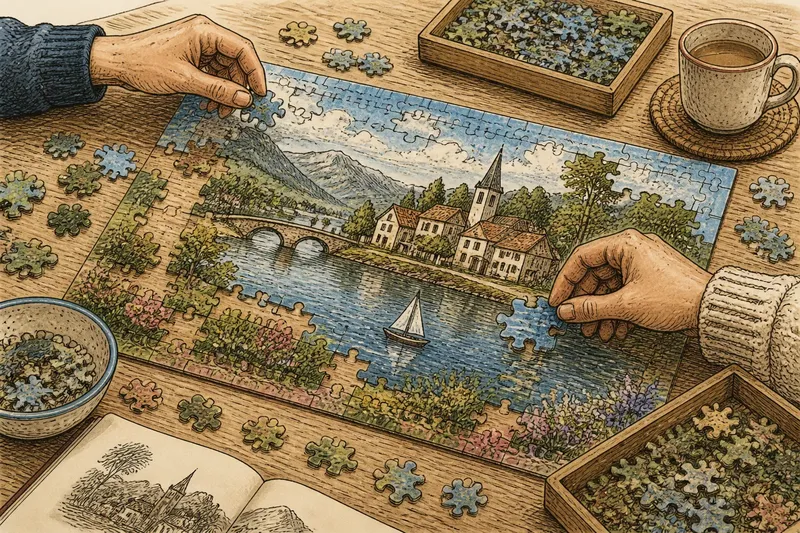
Picture puzzles turn an image into a task you can handle, one fragment at a time. Their early educational use is often described through map puzzles, but without a cited source it is better to treat that origin story cautiously and focus on the lasting shift: assembling a picture can teach, entertain, or simply give people something to do together.
Maps and learning
A familiar account of early picture puzzles describes printed maps mounted on wood and cut into sections for children to reassemble. The details of when and where this practice began need a reliable historical source, so the map puzzle is best understood here as an example of how a picture could become a hands-on learning activity—not as a definitive account of the invention.
Maps lend themselves to this kind of task because their borders, rivers, labels, and coastlines provide visible clues. A learner can compare a fragment with the whole map, then use its printed features to decide where it belongs. The activity makes geography something to inspect and manipulate rather than only read.
The cuts matter, too. A piece that follows a boundary can draw attention to that division, while a piece crossing several features asks the solver to consider how they relate. In either case, the map supplies a practical reason to put the image back together.
Lessons become leisure
When a picture puzzle is chosen for enjoyment rather than instruction, the finished image becomes part of the reward. A landscape, painting, or decorative scene may have no lesson to deliver, but its details still give the solver a reason to look closely.
The clues change with the image. A map offers labels and boundaries; a landscape may offer a roofline, a patch of flowers, or a shift from water to shore. A stretch of similar sky or foliage can be harder because several fragments seem plausible at once.
That balance between effort and visible progress helps make the activity satisfying. A newly placed piece changes a small part of the picture, while the assembled image provides a natural stopping point.
How pictures guide solving
Each piece carries more than one clue. Its outline suggests which pieces might connect, its printed details hint at a location, and its relationship to nearby fragments can become clearer as a section grows.
A lone piece showing a narrow gray line might be difficult to place. Beside a cluster that already forms a roof, the same line may read as a gutter or an edge, giving the solver a more useful decision.
Picture selection and cutting work together. A recognizable object can help only if the pieces preserve enough of its shape or detail to distinguish it; varied outlines can offer extra clues, while similar-looking fragments may call for slower comparison.
Shared tables, separate methods
A puzzle on a shared table allows people to contribute in different ways. One person might sort edge pieces, another might group fragments by color, and someone else might look for a specific object. Their methods can coexist without requiring everyone to follow the same plan.
Imagine two friends beginning an invented landscape puzzle after lunch. One gathers pieces with straight edges and assembles the frame; the other sorts blue fragments and tries them near a visible shoreline. When a strip of coast takes shape, the blue pieces become easier to distinguish by their printed lines, and the friends can use that emerging boundary to decide what to try next.
The activity also leaves room for pauses. Someone can step away and return to a changed image, while another person continues. The shared picture gives the group a common point of attention without making conversation or constant participation a requirement.
Choosing an image
A scene with buildings, lettering, or distinct objects tends to offer clear visual landmarks. Clouds, water, and foliage may ask for more careful comparison because neighboring areas can share similar colors and textures.
For a puzzle you plan to leave on a coffee table, consider who might join and what kind of attention they enjoy. A scene with recognizable details can make it easier for a passing helper to place a piece; a more uniform image may suit people who like patient visual searching.
Picture puzzle questions?
Why do edge pieces help?
At least one straight side identifies a piece as part of the outer boundary. Joining those sides gives the solver a frame to use when judging where interior pieces might fit.
Why are similar colors difficult?
When several fragments share a color, hue alone offers little guidance. Comparing texture, printed lines, and piece shape can reveal distinctions that color does not.
Does everyone need the same strategy?
No. One person can build the frame while another searches for a landmark or sorts by color. These approaches add different kinds of information without requiring a single prescribed route.
What makes finishing satisfying?
The last connection resolves the question of where a fragment belongs and makes the full image readable. It also gives the activity a clear endpoint after many small decisions.
Why the pastime lasts
The picture puzzle is more than an image broken into parts: it gives looking a purpose. A fragment invites a comparison, a connection changes what the solver can see, and the assembled picture turns many small choices into one shared scene.
That is the lasting appeal of a picture puzzle, whether it serves as a teaching aid or a quiet pastime. If you are choosing one for shared time, start with the kind of image people at your table will enjoy studying; the right visual clues can make it easier for someone to join, pause, and pick up the search again.